
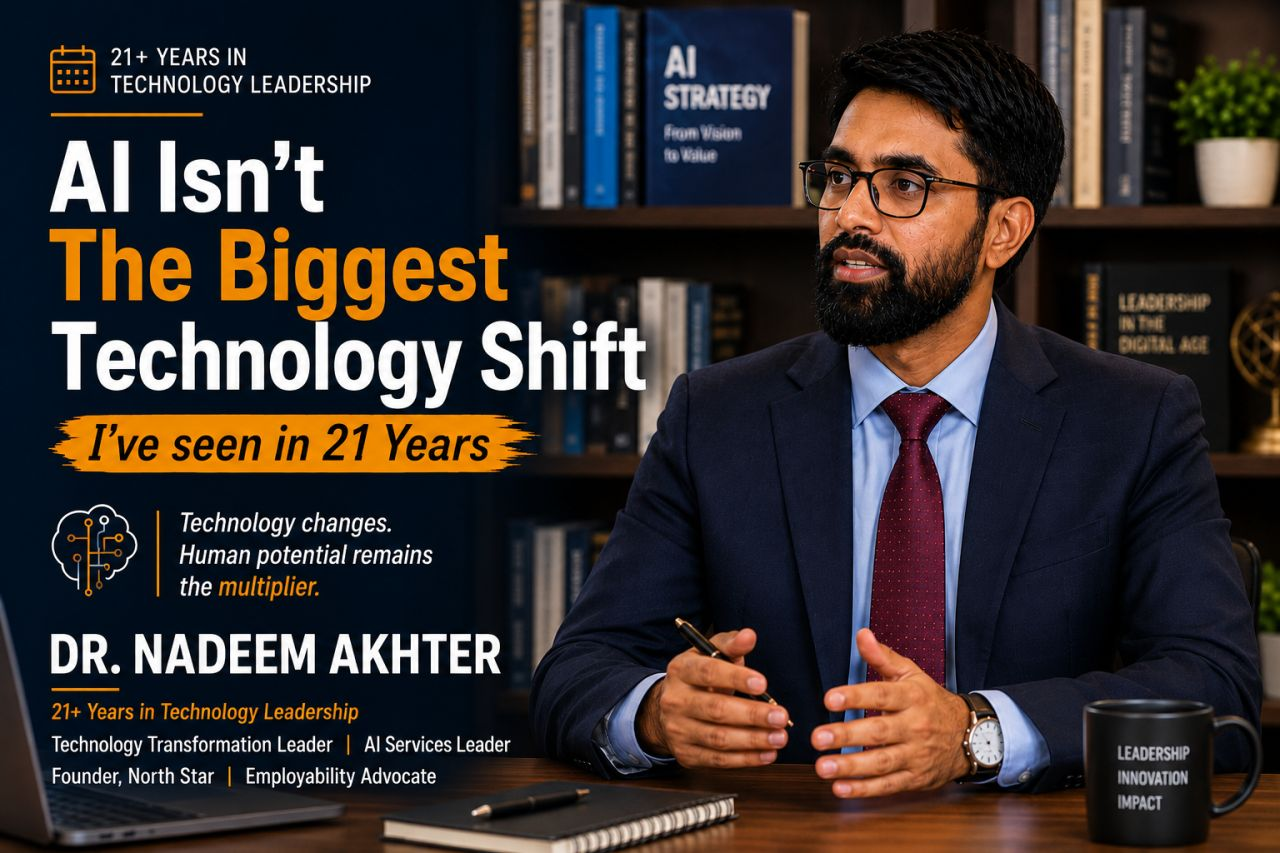
A few weeks ago, a young professional asked me:
"Will AI replace my job?"
What struck me was that I had heard the same fear before.
I heard it when:
- The Internet became mainstream
- Enterprise systems transformed organizations
- Cloud computing emerged
- Automation accelerated
And now, AI.
After 21 years in technology, I've come to believe we're asking the wrong question.
The question isn't: "Will AI replace people?"
The question is: "How quickly can people learn to create value with AI?"
One lesson has remained consistent across every major technology wave I've witnessed: Technology rarely fails because of technology.
It fails because:
- Adoption fails
- Processes don't evolve
- Culture resists change
- Leadership underestimates the human side of transformation
In fact, I believe most organizations today don't have an AI problem. They have a leadership problem disguised as an AI problem.
The companies that win in the next decade won't necessarily be those with the most advanced AI.
They will be the ones that successfully embed AI into:
- Operations
- Decision-making
- Customer experiences
- Workforce transformation
The future belongs to leaders who can bridge:
- Technology and Business
- Innovation and Governance
- AI Capability and Business Outcomes
Because the next competitive advantage won't come from access to AI. It will come from the ability to operationalize AI at scale.
After 21 years in technology, one pattern stands out:
The professionals who benefited most from every technology shift were rarely the smartest. They were the most curious.
- Curiosity drives learning.
- Learning drives adaptation.
- Adaptation creates relevance.
- And relevance creates opportunity.
Technology changes. Human potential remains the multiplier.
Do you believe AI is primarily a technology challenge or a leadership challenge?